PROOF WE WERE THERE
On memory, imperfect records, and life before everything became content.
SIGNAL 002 · SEPTEMBER 2026
WORDS + PHOTOGRAPHS BY TRISHA LYNCH
I. NO CAMERA ROLL
There are entire years of my life that barely exist in photographs.
Not because nothing happened.
Quite the opposite.
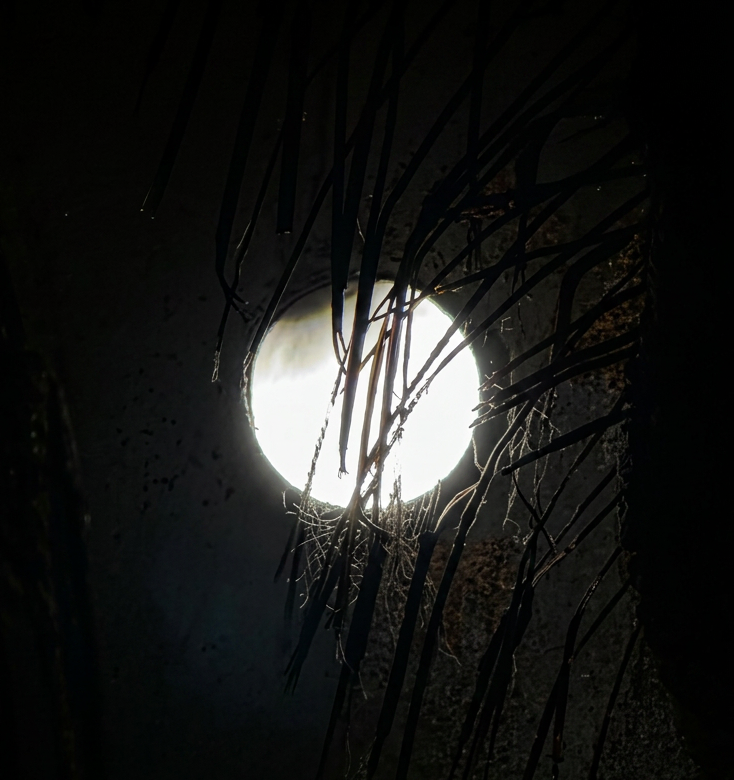
In the late ’90s, my friends and I would sometimes sneak onto a beach cliff at Leo Carrillo late at night. I’d bring my acoustic guitar. We’d sit above the ocean talking, drinking, smoking, laughing, and occasionally serenading the moon because apparently that was a completely reasonable way to spend an evening when you were young and nobody had anywhere particularly important to be the next morning.
I can still see pieces of those nights.
The darkness over the water. The sound of the waves somewhere below us. My guitar in my lap. Somebody passing something around. Conversations that lasted for hours because no one was checking the time. The particular kind of closeness that happens when a group of people is sitting together in the dark with nowhere else to be.
Sometimes I even brought an old video camera I borrowed from my aunt.
It used those little tapes.
So, somewhere along the way, there actually was footage of some of those nights.
And now there isn’t.
The camera is gone. The tapes are gone. Whatever we recorded disappeared with them.
I wish I still had it.
But the memories remain.
That is the strange thing about growing up before every photograph and video automatically migrated into a cloud account. You could document something and still lose it completely. A tape got misplaced. Film never got developed. A box disappeared during a move. A camera broke. A photograph ended up in somebody else’s album.
There was no invisible system quietly making copies of your life.
Sometimes the only backup was you.
And sometimes that had to be enough.
A few years later, in the early 2000s, one of my closest friends at the time gave me a cheap little camera for Christmas.
Nothing fancy. Nothing anyone would have mistaken for professional equipment.
But I loved it.
I started taking pictures of my friends, especially when they weren’t paying attention.
I liked candid photographs. I liked the moments between the moments people usually posed for.
Someone laughing.
Someone lost in thought.
Someone halfway through telling a story.
A look across a room.
The tiny expressions people make when they don’t know anyone is documenting them.
Then I’d take the film in to be developed and wait to find out what I’d captured.
There was something almost ceremonial about getting those envelopes back.
You didn’t know yet.
You flipped through the prints and discovered that someone blinked. The flash obliterated half the room. Somebody’s head was cut off. A picture you were convinced would be perfect came back completely unusable.
And sometimes, buried among all of those failures, there was something extraordinary.
Not extraordinary because it was technically perfect.
Extraordinary because there they were.
Your friends.
That room.
That night.
That version of your life.
Proof.
You didn’t take fourteen versions and choose the most flattering one.
You didn’t immediately inspect the screen and try again.
You didn’t adjust the exposure, remove a blemish, crop somebody out of the background, upload it, caption it, tag everyone, and wait to see whether anyone else thought the moment deserved attention.
You took the picture.
And then you went back to whatever was happening.
There are still enormous parts of my twenties for which I have almost no visual record.
People I once saw every day and now have only a handful of photographs of.
Places I spent hundreds of hours that exist more clearly in my memory than they do anywhere else.
Concerts I remember attending without a single image of myself inside the venue.
Whole nights that became part of the mythology of my life with almost nothing left behind to prove they happened.
And some things, like those nights above the ocean at Leo Carrillo, may once have had proof.
We just didn’t know how temporary the proof could be.
I know those nights happened.
I remember them.
I was there.
Maybe that’s part of why photographs and video mean something different to me now.
Because I belong to a generation that remembers having a life before the camera roll—
and remembers how easily the record of that life could disappear.
ARCHIVE / DATE UNKNOWN
II. PROOF WE WERE THERE
Before we carried cameras everywhere, proof came in stranger forms.
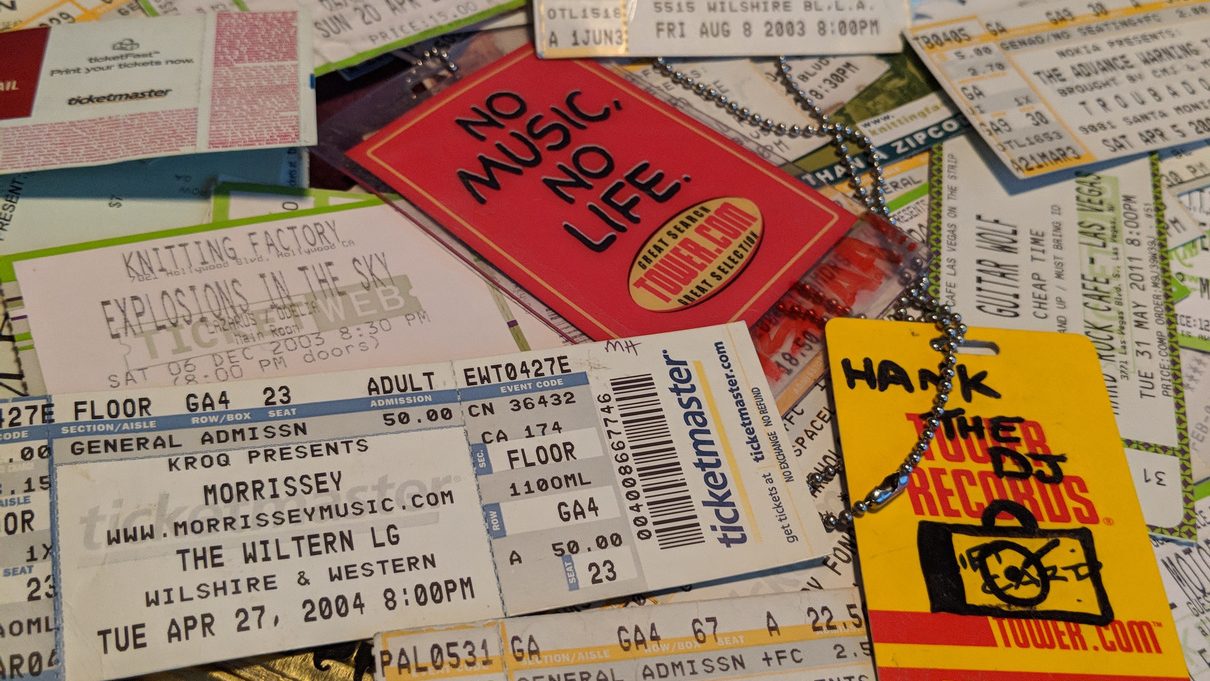
Ticket stubs.
Wristbands.
Flyers folded into jacket pockets.
Signed CDs and posters.
A receipt from somewhere you barely remember.
Things that looked insignificant at the time and somehow became artifacts later.
For me, a lot of those artifacts come from the early 2000s.
From roughly 2001 through 2005, I worked at Tower Records. I eventually became an assistant manager, and for part of that time I also worked the Ticketmaster booth inside the store.
Which, if you loved music, was not a terrible place to be.
I knew when shows were going on sale.
I knew what was coming before a lot of people did.
I could be ready when tickets became available instead of finding out after everybody else.
And this was happening during that particular stretch of the early 2000s when indie rock seemed to be exploding in every direction at once.
All the “The” bands were having their moment.
The Strokes. The White Stripes. The Hives. The Vines.
There was this feeling that something was happening.
Maybe every generation thinks that about the music that finds them at exactly the right age, but at the time it felt like the walls between the mainstream and the strange little corners of music were getting thinner.
I was also playing in an experimental indie band around 2002 or 2003.
So for a while, nearly every part of my life seemed to orbit music.
I worked around it.
I played it.
I sold it.
I bought tickets to it.
I talked about it constantly.
I met musicians and actors and people I never expected to be standing in front of me because Tower Records was still one of those strange cultural crossroads where somebody famous could walk through the door and, for a minute, simply be another person in the store.
Some of those encounters left behind signed memorabilia.
Some left photographs.
Most left only stories.
And even some of those stories are starting to blur.
That’s the part nobody tells you when you’re young.
You assume you’ll remember.
Of course you’ll remember.
How could you possibly forget the person you met, or the show you saw, or the night something happened that felt enormous at the time?
But twenty years does strange things to detail.
The chronology collapses.
Two nights become one.
You remember the room but not the year.
You remember the person but not exactly what was said.
You can still feel the excitement while losing almost everything that would allow you to reconstruct why you were excited in the first place.
Sometimes I’ll find an old ticket or something somebody signed and realize I had nearly forgotten the entire story attached to it.
The object remembers before I do.
Maybe that’s why those things become harder to throw away as we get older.
They aren’t clutter in quite the same way anymore.
They’re timestamps.
They tell us:
You went here.
You saw this.
You knew these people.
This mattered to you once.
For me, those years at Tower were some of the better years of my life.
Not because everything was easy. It wasn’t.
But because I was close.
Close to music.
Close to artists.
Close to shows and records and people who cared about the same things I cared about.
Close enough that, for a while, I could imagine the distance between where I was and where I wanted to go wasn’t very large at all.
It was probably the closest I had ever been to the life I thought I was heading toward.
And maybe that is another reason the surviving pieces from that time feel so important now.
A signed record isn’t really about the signature.
A ticket stub isn’t really about the paper.
They’re evidence of proximity.
Evidence of a version of myself who was there while something was happening and didn’t yet understand that someday she would have trouble remembering the details.
Proof that I didn’t invent the feeling afterward.
Proof that there really was a time when my life revolved around music and possibility and whatever show was happening next.
Proof we were there.
IV. TOO MUCH EVIDENCE
Now we have the opposite problem.
There is too much proof.
Too many photographs.
Too many videos.
Too many screenshots of things we were afraid we’d forget and then forgot to look at again anyway.
Our lives are documented with a thoroughness that would have seemed absurd when I was twenty.
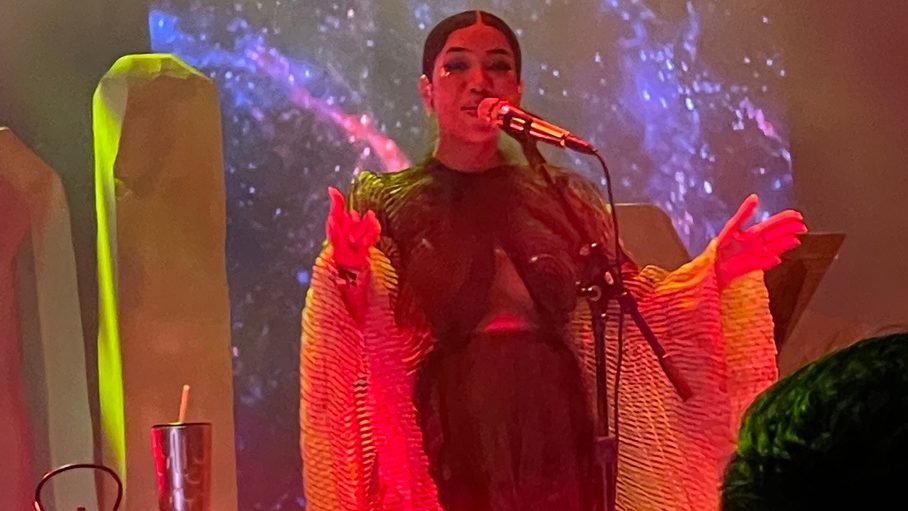
There are entire concerts on my phone.
Thousands of pictures of people I love.
Dozens of nearly identical photographs because apparently I needed to make absolutely certain I had captured the exact expression my dog was making.
Screenshots of conversations.
Screenshots of songs.
Screenshots of things I wanted to buy.
Screenshots of things I wanted to remember to Google later and definitely never did.
And because storage became effectively invisible, we stopped having to choose.
That may be the biggest difference.
Film forced a decision before the photograph existed.
Do I want to use one of my remaining exposures on this?
Digital photography removed the cost of getting it wrong.
The camera phone removed the inconvenience of carrying the camera.
Cloud storage removed the pressure to delete anything.
And suddenly the question changed from:
What should I save?
to:
Why would I delete it?
So we don’t.
We accumulate.
Twenty thousand photographs.
Thirty thousand.
Fifty thousand.
Years of our lives sitting in chronological order inside a device, technically preserved and functionally buried.
There is something strange about that kind of abundance.
ARCHIVE / DATE UNKNOWN
The archive becomes so complete that it can become inaccessible in a different way.
Not because the evidence is gone.
Because there is too much of it to find.
I sometimes think about the difference between opening an old box of photographs and opening my camera roll.
The box has limits.
You can sit on the floor and go through it.
Each photograph interrupts you.
JHENÉ AIKO · THE GREEK THEATRE · LOS ANGELES · 2022
You pick it up.
You turn it over.
Maybe somebody wrote a date on the back.
You remember something.
You call someone into the room.
Look at this.
A camera roll has no natural ending.
You scroll.
And scroll.
And scroll.
A decade becomes a gesture of your thumb.
Whole years flick past in seconds.
You can possess an astonishingly detailed visual history of your own life and still rarely revisit most of it.
That feels like another paradox of modern memory:
We have never saved more, and we may never have looked at less.
The platforms don’t help.
They like to tell us they’re preserving our memories.
On this day.
Five years ago.
Remember this?
And sometimes I genuinely love those reminders.
A photograph appears that I had completely forgotten about and suddenly an entire piece of my life comes back with it.
But there is something unsettling about letting an algorithm decide which parts of my past deserve resurfacing.
The archive may belong to me.
The retrieval system does not.
And increasingly, neither does the place where the archive lives.
Our memories are scattered across services.
Instagram.
Facebook.
TikTok.
Google Photos.
iCloud.
Old hard drives.
Dead laptops.
External drives in drawers.
Accounts attached to email addresses we haven’t used in fifteen years.
Platforms that seem permanent until suddenly they aren’t.
We learned this already with everything that came before.
Websites disappear.
Links rot.
Companies shut down.
Formats become obsolete.
Hard drives fail.
Passwords get forgotten.
A service changes ownership and something you assumed would exist forever becomes inaccessible overnight.
The mini tapes from Leo Carrillo weren’t backed up anywhere.
That was normal then.
What’s strange now is realizing how much of our supposedly permanent digital life may be just as fragile.
Only the containers changed.
And the scale got much, much bigger.
There is another kind of disappearance too.
The photograph can survive while the meaning disappears.
You find an image of a room and can’t remember whose house it was.
A person is standing next to you and their name takes a second longer to arrive than it used to.
You know a photograph mattered because you kept it, but you no longer remember why.
Metadata can tell you when and where.
It cannot always tell you what the night meant.
That’s where the fantasy of perfect documentation starts to break down.
A photograph can preserve an image.
It cannot preserve context automatically.
A video can preserve thirty seconds of sound and movement.
It cannot preserve exactly who you were when you recorded it.
The archive needs memory.
And memory needs the archive.
Each one fills in the holes left by the other.
Maybe that’s why I find myself caring more now about what I keep deliberately.
Not merely what exists somewhere in storage.
The photographs I return to.
The concert clips I actually replay.
The tickets and objects I never threw away.
The images I choose to print.
The things I move from one phone to the next because losing them would feel different from losing the other twenty thousand files.
Because abundance eventually forces the question that scarcity used to answer for us:
Which of these things actually matters?
And maybe the answer isn’t always the best photograph.
Sometimes it’s the blurry one.
The badly framed one.
The video with terrible sound.
The image where nobody knew they were being photographed.
The thing that would never survive a content strategy meeting because it isn’t optimized for anything.
Except memory.
Which brings me back to something I’ve started to understand only as I’ve gotten older:
An archive isn’t everything you saved.
It’s everything you chose not to let disappear.
V. WHAT WE KEEP
So what do we keep?
Not everything.
We can’t.
Even now, with nearly unlimited storage and cameras capable of recording almost every second of our lives, we still make choices.
We just make them later.
We keep the photograph that catches someone exactly as we remember them.
The concert clip where the sound is blown out but the room feels alive.
The ticket stub from a show that changed something in us.
The picture nobody else would understand.
The badly exposed image that somehow contains more truth than the technically perfect one sitting beside it.
We keep the things that still have a pulse.
Sometimes that means the object itself.
Sometimes it means the story attached to it.
Sometimes it means nothing more than knowing that somewhere, in a box or on a hard drive or inside a phone, there is evidence that a particular version of our life existed.
That matters to me more now than it did when I was younger.
Back then, I thought memory was permanent.
I thought the important things would stay important enough to remain clear forever.
I thought I would always remember who was there, what year it was, what we were listening to, what we laughed about, how it felt to sit above the ocean with a guitar in my lap and nowhere else I needed to be.
I know better now.
Memory softens.
Details disappear.
People disappear.
Places change.
Entire versions of ourselves become difficult to access.
And the older I get, the more grateful I am for the fragments that survived.
A photograph.
A signature.
A concert ticket.
A video clip.
A stupid little object I kept for reasons I couldn’t have explained at the time.
They become anchors.
Not because they can recreate the past perfectly.
They can’t.
But because sometimes all you need is one small piece of evidence for the rest of the memory to come rushing back.
I think about those mini tapes from Leo Carrillo more than I probably should.
I would give a lot now for ten bad minutes of that footage.
Not restored.
Not remastered.
Not cleaned up by AI.
I wouldn’t care if the image was grainy or the sound was terrible or half the frame was dark.
I would want to hear our voices.
I would want to see who was sitting there.
I would want to watch myself hold that guitar for thirty seconds and remember what it felt like to be that age, in that place, surrounded by those people, completely unaware that one day I would be trying this hard to remember.
The footage would probably be awful.
It would also be priceless.
Maybe that is what has changed most for me.
I don’t think photographs are valuable because they are beautiful.
I don’t think videos are valuable because they are polished.
And I don’t think an archive is valuable because it is complete.
The value is in what they can return to us.
A person.
A room.
A sound.
A feeling.
A version of ourselves we thought we had lost.
That is also why I don’t feel particularly cynical about the fact that everyone carries a camera now.
There are things being documented today that would have disappeared completely when I was twenty.
Children growing up.
Parents getting older.
Friends laughing at dinner.
Dogs doing something ridiculous.
Songs from the crowd.
Ordinary afternoons that nobody realizes will become important until years later.
There is something beautiful about that.
The camera is not the problem.
The archive is not the problem.
Even the endless camera roll isn’t really the problem.
Maybe the only question worth asking is:
Who are we saving it for?
If every image is taken for an audience, eventually our memories start looking like performances.
But when something is saved simply because we want to remember—
because the light looked a certain way,
because somebody we loved was laughing,
because the band played the song,
because for a few hours we were exactly where we wanted to be—
then the photograph becomes something else again.
Not content.
Not proof for strangers.
Just a small act of resistance against forgetting.
Maybe that is what an archive really is.
Not everything we captured.
The things we decided were worth keeping.
The things that still mean something after the audience has moved on.
The things we carry from one version of ourselves into the next.
And sometimes the things we lost, but still remember clearly enough that their absence becomes part of the archive too.
I don’t have the tapes from Leo Carrillo.
I don’t have photographs from every concert.
I don’t have evidence of every person I loved, every place I belonged, every night that became part of me.
But I remember enough.
And for the pieces that survived, I’m grateful.
They remind me that before everything became content, it was simply life.
Messy.
Uncurated.
Badly exposed.
Sometimes completely undocumented.
And still worth remembering.
Proof we were there.

